


Detox patches "Lavender" with tourmaline

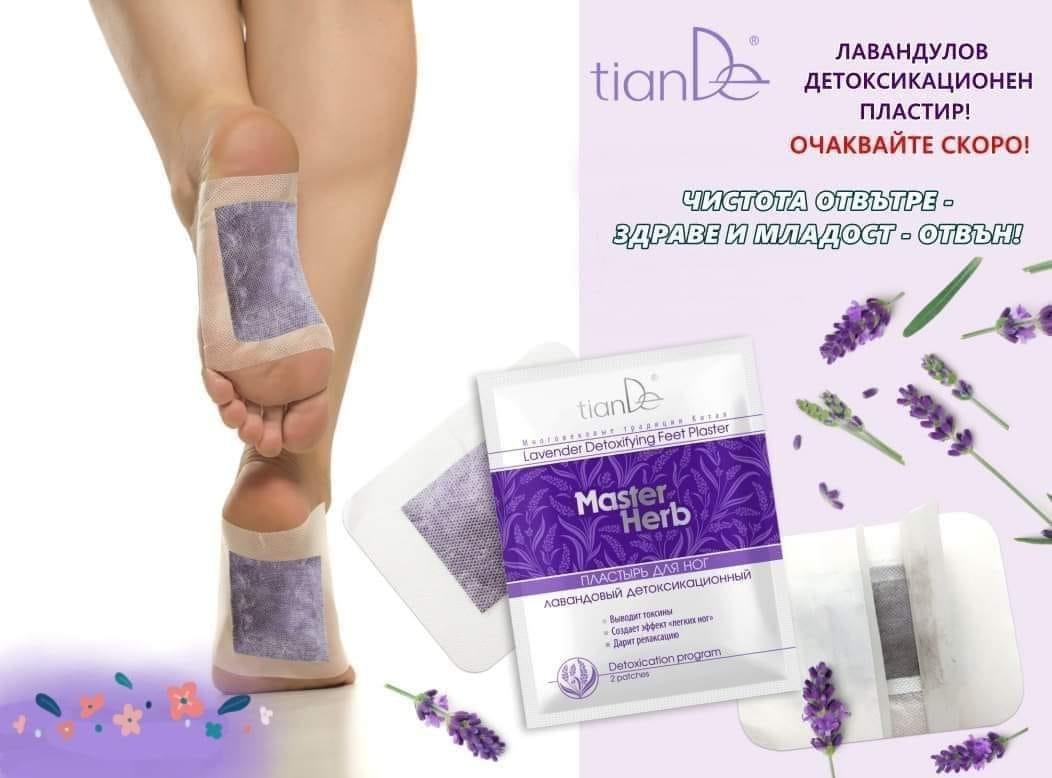
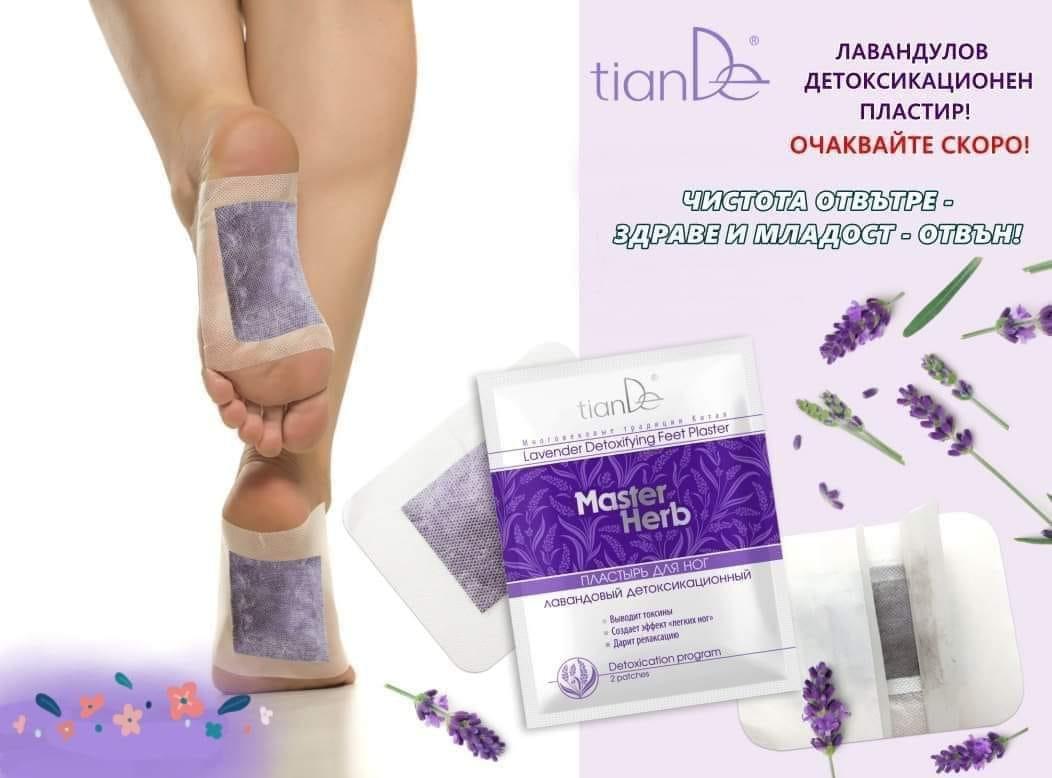

Lavender detox patches with tourmaline, TianDe
Detox patches with lavender and tourmaline
Do you feel tired right after waking up and get exhausted quickly? It seems that colds and allergies have become more common, and the condition of the skin and hair has deteriorated.
Heaviness in the body, weakness, drowsiness, loss of appetite, irritability - all these are just some of the signs of intoxication. Your body needs "cleansing"!
Purity inside, health and youth - outside!
Lavender detox patches are a combination of centuries-old Chinese traditions and modern developments.
The active ingredients in Lavender Detox Patches with Tourmaline:
- affect the acupuncture points located on the foot, helping to cleanse the body;
- activate the process of elimination of toxins and harmful substances;
- help reduce discomfort, fatigue, overexertion and the feeling of "burning feet".
In China, the steps are called the "second heart" of man. According to the theory of traditional Chinese medicine, there are more than 60 acupuncture points on the feet, as well as reflex zones connected to many of the internal organs. On the steps are the important energy channels "jinglo", in which slag from the human body is deposited for a long period of time. These toxins interfere with the normal flow of blood and can cause various diseases.
The main purpose of the lavender patch is to carefully and gradually cleanse the body of toxins and accumulated toxins.
The composition of the patch is reinforced with tourmaline, which improves lymph movement, speeds up the cleansing process. The result of regular and complete "cleansing" of the body: improving overall well-being, lightness on the inside and beauty on the outside!
Application of Lavender Detox Patches with Tourmaline:
Use during sleep. It must be used immediately after opening the package.
Print the patch the night before bed. Inside you will find two patches for both feet. Remove the protective paper, stick the patches on the adhesive side and on the very well cleaned skin of the feet, press to fix.
The minimum duration of action of the patch is 6-8 hours, the optimal - 8-10 hours, in case of disease - 12-24 hours. It is recommended to apply the patch from 20:00 to 21:00, before the biologically active points "open". It is also possible to apply it on a sore spot. In the morning, peel off the patch and rinse your feet with water.
For effective cleansing of the body, the recommended course is 7-10 days.
Not recommended during pregnancy and lactation.


How do you know if you need a detox?
- You wake up tired.
- Your weight began to increase for no apparent reason (eat the same way as before).
- The appearance "does not obey" the cosmetics: the hair looks lifeless and the skin - dry and tired.
- Allergic manifestations and colds are becoming more common.
- You feel constant heaviness and fatigue.
- You often experience headaches, weakness and drowsiness.
- Your ability to work has decreased, you feel tired, apathetic and irritable.
- You can not sleep for a long time and suffer from insomnia.
- Excessive sweating has occurred.
- Decreased appetite.
The result of regular and complete "cleansing" of the body is the improvement of general well-being, lightness on the inside and beauty on the outside!
Ingredients: complex of natural sorbents:
 Hitin - a powerful sorbent of natural origin that absorbs waste, toxins and salts of heavy metals released by the body.
 Chitosan - a polysaccharide derived from chitin, which binds and removes toxins and heavy metals.
 Dextrin - polysaccharide obtained by heat treatment of potato or maize starch. Perfectly absorbs moisture and removes toxins and heavy metals from the body.
 Bamboo vinegar - thanks to its high penetrating and absorbing ability, activates the removal of harmful substances through cell membranes and skin pores, stimulates the excretory system. It has antimicrobial action.
 Tourmaline to dust - obtained from a mineral that has an electromagnetic field. When interacting with the human body, tourmaline activates blood circulation and enhances lymph movement, accelerates metabolism at the cellular level, opening the "exit" to toxins.
 Lavender extract - improves blood circulation, removes toxins from the layers of the dermis, has a beneficial effect on the body as a whole, improves sleep quality.
 Vitamin C - restores the body, perfectly stimulates the immune system, reduces the incidence of disease and has a positive effect on cell health and youth.
The foot is one of the most congested and underestimated parts of the human body. During an average human life, each foot comes into contact with the earth more than 10 million times.
Out of a total of 206 bones that make up the human skeleton, 52 are located only in the feet - 26 each.
The foot has 33 joints, 107 tendons and 19 muscles.
The foot is the platform that bears the weight of the body while standing and moves it while walking, running and jumping. The feet are a very special part of the body. They give us stability, make it possible to walk and are always in touch with where we are, no matter what situation we are in.
From an anatomical point of view, the construction of the lower limbs differs significantly from that of the upper, because they are the ones who have to take all the weight of the body. Unlike the palm, the foot carries the weight of the body to the greatest extent and its structure fully corresponds to this role. In order to distribute this weight evenly, the bones of the foot form an arch, supported both by the shape of the bones, ensuring close contact between them, and by the muscles and ligaments of the foot. Structure that provides elasticity and absorbs shock in the event of sudden changes in load, such as simple movements such as walking, running and jumping.
Our feet contain about 250,000 sweat glands that secrete a glass of moisture every day. The feet contain more sweat glands and sensory nerve endings per square centimeter than any other part of the body.
They are obviously also good for growing cheese. An exhibition in Dublin in 2013 showed a variety of cheeses made from samples of bacteria obtained from the human foot, armpits and navel. Tempting! It is a relief to know that no one has eaten these cheeses.
People have nearly 8,000 nerves in the feet and a large number of nerve endings near the skin. If you have tickling in your feet, this may be a good sign: decreased sensitivity may be an indicator of neuropathy. The foot contains pain receptors as well as touch receptors. Tickling can affect both types of receptors. That's probably why some people don't like to be tickled on the legs.
Walking is the best exercise for the legs.
It improves circulation and weight control, and thus overall health. Recent studies show that exercise in general gives a positive boost to brain activity and leads to improved memory, concentration and mood.
The two steps are almost never exactly the same, one is usually longer than the other. We have to choose shoes according to the bigger one. And it is best to choose in the afternoon, because during the day the foot increases its volume by an average of 5%
When walking, with each lift of the heel, the toes take up about half of your weight. Runners hit the ground with a force equal to 2.5 - 3 times their own weight
In one day of normal walking, the total load on the legs can reach hundreds of tons, which is equivalent to a truck loaded with cement.
In one life a person walks over 160,000 km - ie. orbits the earth four times.
Women suffer about four times more leg problems than men. These are mainly due to the shoes they wear. Ironically, Western women began wearing heels to achieve a more masculine appearance: European men borrowed their appearance from Persian warriors in the 17th century, and women soon followed suit.
Standing still is much more tiring than walking, because the same muscles are loaded for a longer period of time.
Sickness and pain in the legs may be the first signs of more serious illnesses. Legs reflect general health, so arthritis, diabetes, neurological or circulatory disorders can show their initial symptoms in the legs.
People have been wearing shoes for thousands of years
When do people start wearing shoes? About 40,000 years ago, according to research from the University of Washington in St. Louis, which analyzed the bones of the legs of Neanderthals and early humans. The toes of our ancestors were thicker and stronger due to the fact that they walked barefoot and had to deal with any terrain. This is the time when archeological records show an abundance of artistic and technological achievements among the early people, including the first stone tools that may have contributed to the production of footwear. The oldest preserved shoe, by the way, is 5,500 years old and was found in an Armenian cave buried in sheep manure.
The big toe was like a toe.
By gripping, this soil has helped our ancestors climb trees and, when they are young, cling to their mothers. Thanks to modern science, if you lose your thumb, you can now replace it with a finger: finger transplants are a surprisingly common procedure nowadays.
The foot bears evidence of the evolution of bipeds
Scientists are studying Homo naledi - a specimen discovered in a South African cave in 2013, which many researchers consider a new human relative. Homo naledi has legs similar to human, but with slightly curved bones, which indicate that he climbed trees. It is possible that Homo naledi started experimenting with walking.
The size of the steps is constantly increasing
The legs lengthen and widen to maintain the extra weight. According to a 2014 study by the College of Podiatry in the UK, the average foot has increased by two sizes since the 1970s. As people get taller and heavier, their legs respond through growth. It seems that many people still deny the fact that their legs are growing. Although retailers are starting to react by making bigger and wider shoes, half of women and one third of men report buying bad shoes. Podiatrists claim that a significant part of the foot problems are due to the wrong size and width of shoes, especially among women.
There's a reason Grandpa's nails look like that
Have you ever heard someone describe their fingernails as "horse hooves"? As we age, our toenails tend to harden, making them difficult to cut. This happens because the nails do not grow more slowly with age, which increases the accumulation of nail cells. Strokes on the toes, squeezing the shoes can also cause thickening, as well as fungal infections and peripheral arterial disease, in which the arteries narrow and reduce blood flow to the limbs.
Read interesting and useful articles in our Blog
You can also check out the Russian official website of Tiande
Related products
-
- Accessories, For the face, Special and anti-aging products, TIANDE
Mesoroller - massage roller
- 56.65 € (BGN 110.80)
- Add to cart
-
- Accessories, TIANDE
Natural sponge for washing "Cognac"
- 7.87 € (BGN 15.40)
- Add to cart

